In Short
- AI is useful for fast concept images, first-pass plant shortlists, 3D visualisation and sun and shade modelling.
- It can’t assess a site: it doesn’t know your soil, your drainage, your levels, what’s buried under the lawn or what council will allow.
- AI garden apps are mostly built for a global audience, so their plant suggestions need checking against Melbourne conditions.
- The best use of AI for a homeowner is working out what you like before you talk to a designer.
- The decisions that make a garden work on a real site still come from people who have built on similar sites before.
Upload a photo of your backyard to an AI garden app and thirty seconds later you have a lush, photographic garden that looks ready to move into. There’s a curved path, a pergola, a row of mature trees and a lawn that’s never seen a Melbourne February. It’s a lovely picture. Whether any of it could be built on your block is a different question.
AI landscape design tools have improved quickly, and plenty of homeowners now arrive at a first meeting with a folder of generated images. We treat those folders as a good way to start a conversation, not to finish one. Here’s where AI helps with garden design, where it falls short, and how to get the most out of it.
How AI is used in landscape design today
AI in landscape design covers a handful of different tools doing different jobs. Some produce images, some suggest plants, and some add speed to professional 3D modelling. Each is good at something specific.
Concept visualisation from a photo
Generative image tools take a photo of your garden and redraw it in a chosen style: Mediterranean, coastal, native, Japanese-inspired. They’re fast, cheap and good at conveying mood. They’re also inventive in the wrong ways. Steps appear where the levels don’t allow them, trees are drawn at fifteen years’ growth, and a path runs through where the sewer inspection point sits. Treat the result as a mood board, not a plan.
Plant selection against site conditions
AI plant tools can suggest species for a given aspect, style or maintenance level, and plant identification apps can name what’s already growing. They’re a useful first filter. The catch is that most are built for a global audience, not for Melbourne. Some sort plants by US hardiness zone, a system based on average winter minimum temperatures (USDA), which says a lot about frost and very little about a Melbourne summer on reactive clay. A shortlist still needs checking against local conditions, and against what grows well in your part of the city.
3D renders and walkthroughs
Professional 3D design software increasingly uses AI to speed up rendering, texturing and planting visualisation. The result is a far more realistic picture of a design than a hand-coloured plan. It’s worth remembering that a render is only as accurate as the site model underneath it, and that model still has to be measured.
Sun and shade modelling
Sun path simulation is one of the most reliable uses of digital design tools. With a 3D model of the house, fences and neighbouring buildings, you can see where shade falls at 9am in June or 4pm in January. It’s accurate for structures. It’s much less reliable for trees, which grow, get pruned, lose leaves or get removed.
Site capture
Phones with LiDAR scanners can now produce a rough 3D model of a garden in minutes. It’s a good starting point for visualisation. It isn’t a level survey, and it doesn’t show services, soil or drainage.

Where AI falls short in garden design
| Decision | What AI can offer | What it can't do |
|---|---|---|
| Site assessment | A picture based on a photo | Walk the block after rain and see where water sits |
| Soil and drainage | General advice for a soil type | Tell compacted clay from good loam, or find the wet spot |
| Levels and retaining | A drawn slope | Measure falls, set heights against the house or size a retaining wall |
| Buildability | An image of the finished result | Work out whether an excavator fits down the side of the house |
| Services and approvals | Nothing reliable | Locate buried pipes and cables, or read overlays and tree protection |
| Long-term performance | A plant list | Know how a material weathers or which plants survive a Kew summer in shade |
Services are a good example. Before any digging, underground assets need checking through Before You Dig Australia, and planning overlays, tree protection and building permits all vary by property. None of that is visible in a photo.
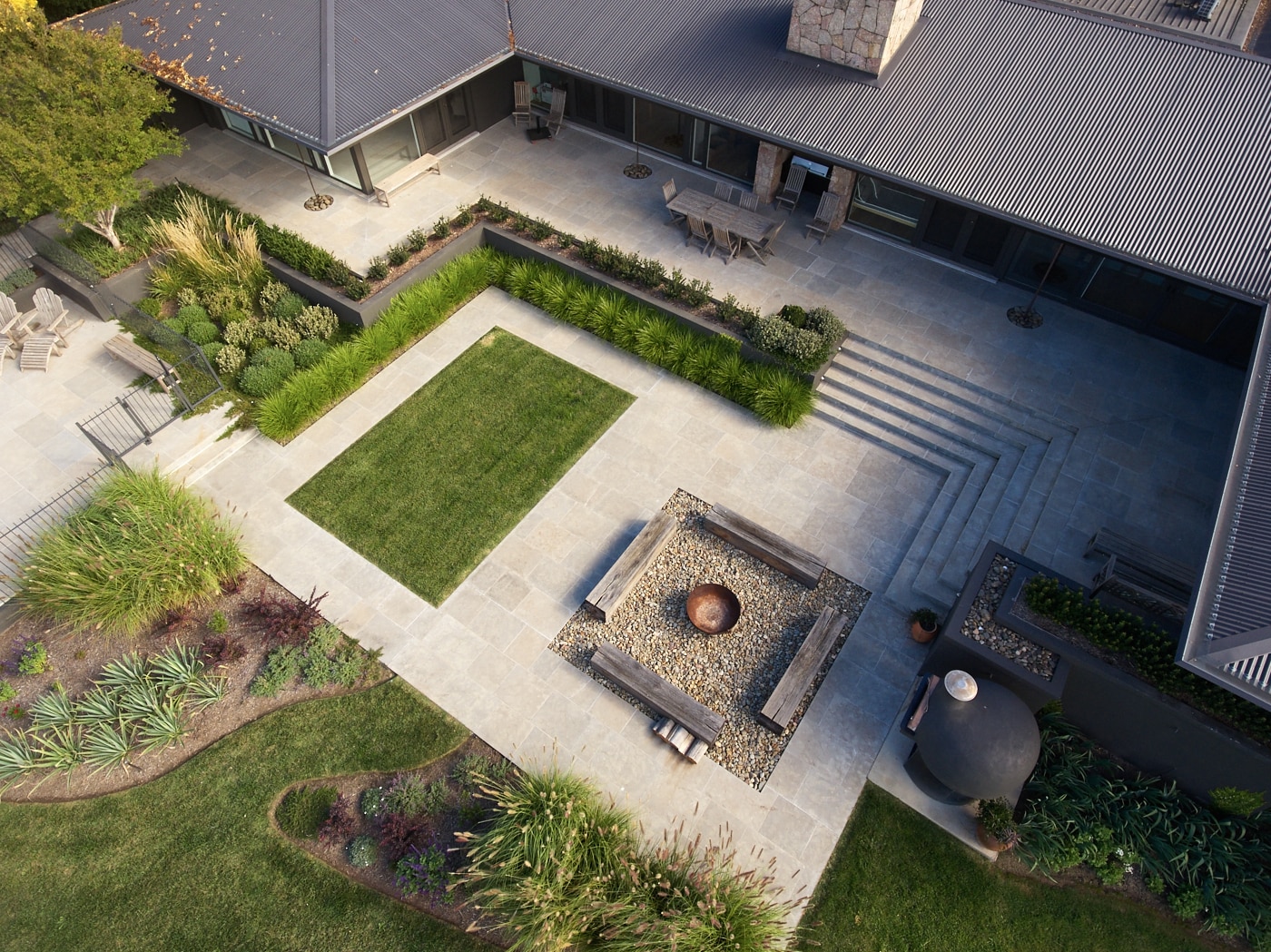
The larger gap is judgement built from experience. On our Toorak Poolside project, the block sloped steeply from front to back. The design sank the pool into the slope, with one side partly exposed above ground, so the pool sits into the terrain rather than on top of it. Along the raised edge, the pool wall itself forms part of the compliant barrier, so no separate fence was needed there and the view through to the tennis court stays open. In Glen Iris, a sloping site was resolved with a bridge from the footpath to the front door. Those are decisions that come from reading a specific block, and they’re a large part of how we approach pool landscaping. An image generator would have drawn a pool and a path.
How to use AI garden design tools before you talk to a designer
- Generate plenty of options. Try several styles, not just the one you think you want.
- Keep the ones you react to, positively or negatively. What you dislike is as useful as what you like.
- Note what draws you in. Is it the material, the colour of the planting, the sense of enclosure, the lighting?
- Ignore the layout and the plant names. Those are the parts most likely to be wrong for your site.
- Measure a few basics. The rough size of the space, which way it faces and where the sun falls at different times.
- Bring the images to a consultation so the designer can see your taste, then test it against the site.

What AI means for the future of gardens
AI will make garden design faster to communicate. More people will arrive with a clear picture of the style they want, and designers will be able to show options and changes more quickly. Plant selection tools will improve as they draw on better local climate and soil data.
What won’t change is that gardens are built in real ground. Clay still moves, rain still has to go somewhere, and a design still has to be buildable by a team on a specific site with specific access. The value of an experienced designer is increasingly in the judgement between the image and the build: knowing which parts of an idea will work on your block, and what to do about the parts that won’t.
Key Takeaways
Use AI images to explore style and work out what you like, then leave the layout to someone who has measured the site.
Check every AI plant suggestion against Melbourne conditions, because most tools aren’t built around local soil and climate.
Sun and shade modelling is reliable for buildings and fences, less so for trees that grow or change.
Site assessment, soil, drainage, levels, services and approvals still need someone on site.
Bring your favourite AI images to a designer so the conversation starts from your taste.
AI landscape design FAQ
It depends on what you want from it. For exploring style, most image-based apps do a similar job, and the tools change quickly. Whichever you use, check its plant suggestions against Melbourne conditions.
Accurate for mood, unreliable for detail. Proportions, plant sizes, levels and anything below ground are often wrong, because the tool is working from a flat image of the site.
It can give you a starting list. Whether those plants will thrive depends on your soil, aspect, shade, wind and summer watering, which is why a local check matters.
Yes. They’re one of the quickest ways to show a designer what you like. Just expect the designer to keep the feeling and change the layout.
It’s more likely to change how designers work than replace them. AI speeds up visualisation, but site assessment, buildability and construction judgement still depend on experience.
No. A render shows what the garden will look like. Construction documentation specifies levels, materials, dimensions and methods, and that’s what a garden is actually built and quoted from.
If you’ve got a folder of AI images and a garden that doesn’t match them yet, bring both to a landscape consultation. We’ll look at what you like, test it against your site and scope the work from there. You can also browse our recent projects or get in touch.